Can a Bot Win at Poker? What We Learned From Libratus and Pluribus
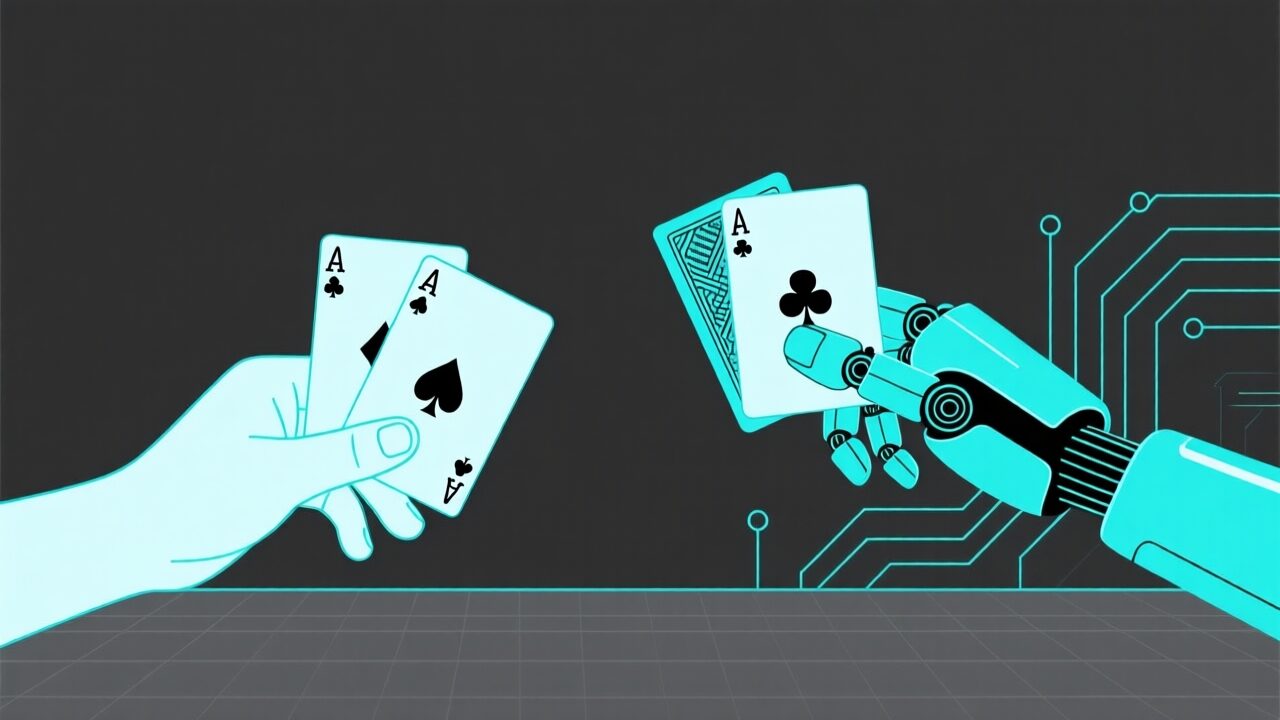
If poker is decided by skill and math, the question follows on its own: shouldn’t a machine sweep any human? The answer is yes, it has already happened, but it cost far more than it looks. Two bots proved it years apart, and the interesting part isn’t that they won, it’s how they did it. Out of that come lessons you can apply without being a supercomputer.
This article is the natural sequel to whether poker is luck or skill. There we said skill is so real it can be programmed. Here we look at who programmed it.
Libratus (2017): winning without bluffing like a human
In January 2017, at the Rivers Casino in Pittsburgh, a bot called Libratus (from Carnegie Mellon University, built by Tuomas Sandholm and Noam Brown) sat down against four of the best heads-up no-limit players in the world. They played 120,000 hands over 20 days. Libratus won by a huge margin, on the order of 1.7 million in chips.
What stood out was its style. It never tried to trick anyone by reading them. It played a balanced equilibrium strategy, so balanced that the four pros couldn’t find a single pattern to exploit. Every hand was bluffed at exactly the frequency that made it impossible to tell whether it was strong or air.
And it had a brutal third weapon: every night, while the players slept, Libratus analyzed the lines that had attacked it most during the day and patched its own leaks for the next morning. The humans would find a crack, and by the time they woke up it was gone. Against an opponent that fixes itself every 24 hours, no hot streak holds up.
Pluribus (2019): the jump to a real table
Libratus dominated one on one, but real poker is played six-handed. And there the problem gets much harder, because with more than two players the theory no longer even guarantees that an “optimal” strategy wins. Implicit alliances and dynamics appear that heads-up doesn’t have.
In 2019, Pluribus (by Noam Brown, now at Facebook AI, with Sandholm) cracked exactly that: it beat elite players at six-handed tables. Two details make it fascinating:
- It was cheap. No server room required. Pluribus trained in about 8 days for roughly 150 dollars of cloud compute and played in real time on two ordinary CPUs. Raw power wasn’t the secret.
- It played weird, and it was right. It used bet sizes the pros avoided and made plays considered “bad,” like betting into pots that classic theory said to check. They worked. Several of those moves were later adopted by the humans themselves.
What you can steal from the bots
Here’s the useful part. You won’t have Pluribus in your pocket, but its principles are free and copying them takes no CPUs:
- Balance before tricks. Bots win by being impossible to read, not by being clever. Bluff and value-bet in consistent proportions, not on a hunch. Estimating your equity well is the first brick of that, and you can drill it on its own with the equity calculator.
- Bet size matters more than you think. Pluribus’s biggest surprise was using sizes humans had dismissed out of habit. Stop betting “half pot” on autopilot and think about which size costs the opponent’s range the most.
- Think in ranges, not hands. Neither Libratus nor Pluribus tried to guess two specific cards. They worked with the whole spread of what the opponent could hold. The range visualizer trains that same way of looking.
- Never tilt. The bot plays the millionth hand after a bad river exactly like the first. That coldness is its biggest edge over you, and it’s the one you can match today without knowing more theory.
What bots still don’t do
Before surrendering to the machines, two caveats. An equilibrium bot plays to not lose, not to squeeze a weak opponent. Against a loose, predictable player, a great human exploiter who adapts can win even more money than the bot, because the bot stops punishing the mistakes that equilibrium ignores. And variance still rules the short run: even Pluribus loses individual sessions. It wins over the long haul, not every night, like anyone else.
The practical conclusion is reassuring. That a bot exists which can beat you doesn’t mean you’re doomed in your Friday game, where there are no bots. It means the map of perfect play is already fairly drawn, and you can move toward it by copying its principles: balance, good sizing, thinking in ranges and zero tilt. All of that is practiced with real hands, scored against the correct play, in your training, and tested against bots in the table simulator without risking a cent.